Sunday, February 28, 2010

3d stories


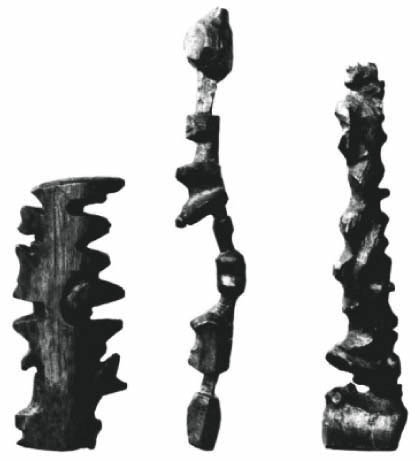
"Two years ago, Colleen Morgan of Middle Savagery pointed out these amazing tactile maps of the Inuit, '3D wood carvings of the East Greenland coastline, with the details of inlets and islands in sculptural relief. These could be employed by [travelers] at night in conjunction with the stars, feeling your way along the coastline, navigating at an intimate scale.'"

Link

What I Read Last Week: Part 2

Drawing on the Right Side of the Brain
by Betty Edwards

When this book was referenced in Drawing in Writing (as quoted in the last post), I immediately pulled this book from the shelf behind me...I hadn't even thought to look at it in relation to the inde. study. My Pop-Pop bought this copy when it came out and I used to read it at my grandparents' house when I was little...it was probably the first 'drawing' book I ever read, although early on I mostly looked at the pictures and did the exercises. I love this groovy photo of Betty Edwards on the back:


Some passages I like (emphasis mine):

“As it turned out, my friend’s son always learned visual material best and fastest, a mode of learning consistently preferred by a certain number of students. Unfortunately, the school world is mainly a verbal, symbolic world, and learners like Gary must adjust, that is, put aside their best way of learning and learn the way the school decrees. My friend’s child, fortunately, was able to make this change, but how many other students are lost along the way?"

"This forced shift in learning style must be somewhat comparable to a forced change in handedness. it was a common practice in former times to make individuals who were naturally left-handed change over to right-handedness. In the future we may come to regard forcing children to change their natural learning modes with the same dismay that we now regard the idea of forcing a change in handedness. Soon we may be able to test children to determine their best learning styles and choose from a repertoire of teaching methods to insure that children learn both visually and verbally.” p196

Exercises in Visual Thinking
by Ralph E. Wileman

This book has some fascinating stuff about designing intelligent, effective, and/or beautiful educational materials...but don’t necessarily have time to veer off on that tangent too far. I sort of accidentally fell into the educational tangent last week...which was really interesting. It's a sector that I hadn't even considered in my original outline.

I like this definition of visual literacy:
“Visual Literacy: The ability to ‘read’ and understand that which is seen and the ability to generate materials that have to be seen to be understood.”
The book also has lots of really fun illustrations of concepts.


What I Read Last Week: Part 1

This is the first of some long posts about books I read last week..just collecting lots of quotes and passages from a few books I read last week that I--sadly--have to return to the library :(

Drawing/Writing and the new literacy: Where verbal meets visual
By Susan Rich Sheridan


Here's a summary of what the book is about from the author's website:

"To an unprecedented degree, a technological society requires visual literacy skills as well as verbal. This combination of visual and verbal skills, or the ability to produce image as well as text, is "the new literacy." Children's natural drawing skills and their tendency toward a broad range of communicative marks is often marginalized or misunderstood. Technology's requirements for this new literacy forces us to take another look at spontaneous mark-making behavior - scribbling and drawing - in children, and to respect it and encourage mark-making as the place where this new literacy - in all its range and variety - begins. Dr. Sheridan's books meet this demand for multiple literacy skills by encouraging the natural capabilities of our brains, starting with the universal skill that everyone can do, drawing.


Hand logoThe abilities to write and to read depend upon core skills including the ability to pay attention, to extract information, to communicate ideas and emotions clearly, and to use both words and images. In short, to use the whole brain. These skills can be learned through training in drawing. Drawing is a universal skill. Everyone can draw. No one teaches us how. Drawing is a language instinct.
When talking and writing accompany drawing, verbal skills grow and a double literacy develops, both visual and verbal. This “new literacy " is as old as paleolithic cave drawings and as new as computer technology. The New Literacy rests on a new theory of multiple literacies. Humans as language-users have one unique characteristic: they make marks of meaning. These marks first take the form of scribbles. Then, children draw. The marks are equipotential: they can become anything: drawing, writing, mathematics, musical notation. The number of systems for meaning-making each of us learns depends upon opportunity, encouragement and instruction. It depends on our parents, our teachers, our environment, and our culture. Ultimately, it depends upon our brains and how we choose to use them."

The book has some chapters on theory and then the rest are chapters detailing how to include her exercises in a curriculum. (Not so applicable to me...I only read the theory chapters). Some passages that really jumped out at me from the book:


“The similes and metaphors routinely produced with each Drawing/Writing step as well as additional exercises with analogy, speculation, prediction and hypothesis train the bihemispheric brain to produce left/right, or verbal/visual messages where the combined information is what counts--not text, not image alone.”

“The slash between the words Drawing/Writing signals the following:
  • a cross-modal, or interhemispheric relationship exists between these two mental activities
  • the relationship is integrative and transformative
  • an exchange of information is occurring between two closely related mental enterprises
  • the results are both more precise and richer than those in which these mental enterprises are pursued apart from each other”

“The nickname for the CA (Composite Abstraction) is “the new hieroglyphics.” Egyptian hieroglyphics evolved form the pictorial to the phonetic; a picture of a vulture came to stand for the initial sound of the word “vulture.” In somewhat the same way, an optically accurate drawing changes its form in Drawing/Writing by becoming an abstraction, recapitulating the process of the invention of writing from drawing.”

“They know they can make marks that do not looks like an object but which describe it in new ways. They understand a very powerful idea: symbolic representation. The very young student who practices CA’s is ready to believe that the abstract drawings he has created are like writing. If his CA carries meaning, writing will carry meaning. it is at this point that the child can be introduced to the idea that mathematical notation-whether arithmetic, algebra or calculus--or, for that matter, musical notation, will be meaningful, just as abstract paintings will be meaningful.

The gulf between symbol systems is not as wide as we imagine. Children can draw their way toward mathematical operations.”

“On the other hand, children are born ready for symbol systems. Every representation children construct in their brains is an abstraction. Serious play with abstraction need not be withheld until a certain time or grade. Children demonstrate their readiness for meaningful-making through spontaneous scribbling and drawing. Serious work with abstract symbols can be achieved through the CA before children are able to write or read. This work is not only preparatory. It is legitimate work in and of itself."

"The ability to make and use visual symbols is as important as being able to make and use verbal symbols, and a lifetime of confidence in verbal symbols may--for some children--depend on it."

“Betty Edwards’ book, Drawing on the Right side of the Brain, helped to popularize brain science, providing practical applications of drawing which she took successfully into the worlds of education and business. She offered two important observations: Everyone can draw, Drawing is thinking.
The theories in this book expand an appreciation for drawing:
Training in drawing has general cognitive usefulness for teaching descriptive, analytical and inferential thinking skills. If training in drawing is combined with reflective writing, literacy becomes an integrative enterprise in which encoding and decoding skills extend well beyond words to all symbols including mathematics.
Drawing is no more an exclusively right-brained activity than writing is an exclusively left-brained activity. Both activities involve global mental operations including interhemispheric transfer.
With this understanding, polarizations like “logical versus illogical,” “creative versus critical,” or “intuitive versus rational” lose their power. Brain science blurs or even eliminates such distinctions. WholeBrain classrooms accept visual and verbal modes as equally viable approaches to learning and communication. ...Some brains will excel at visual thinking and some brains will excel at verbal thinking. WholeBrain teaching avoids lables like “right-brain thinking” or “left-brain thinking,” particularly as predictors of academic success. The goal in WholeBrain thinking is the growth of balanced, cooperative visual and verbal skills”

Right brain/Left brain is more like Moebius strip.

Catching Up

I've been playing catchup since last Wednesday in all my class because I caught the dreaded norovirus (read, stomach virus from hell). At first I thought I had food poisoning because it hit me like a sack of bricks right after studio at around 6. No warning. I'd felt fine all morning (I'd eaten about half a bag of "sweet 16" donuts at work that morning...sooo was definitely feeling fine then) and then by that night I was totally miserable. Suffice it to say, the above picture accurately depicts my diet (and hairstyle) from Wednesday until Sunday. Not pretty. But I'm happy to say that since Tuesday I've consumed pizza, pickle chips de Raleigh Times, and several meals at Clark cafeteria with no ill results. So back to 110% now, which is good because I have roughly a million things to do before my trip to LA in two weeks.
  • Catch up on all my inde study stuff (working on it...be prepared for several posts to follow all at once from stuff I've been working on since last week)
  • Catch up on capstone stuff
  • Catch up on back labs in agricultural and resource economics (did that yesterday...anybody need me to do your taxes or explain that concept of a quasi-public good? I'm your woman)
  • Polish the 3rd draft of the essay I'm writing for Stephanie for her capstone project (I may post the final draft up here for comments even though it's not directly related to inde study stuff)
  • For Biomedical Ethics: Write a response essay to an argument about abortion that we're going to debate this week (eek)
  • and obviously continue to keep the creative juices flowing at work for 20 hours a week (last week successfully designed and wrote copy for a logistics firm, designed some logos, and made a brochure that made pictures of exhaust tips and fuel tanks look sexy).
Also I've got to get my butt in gear and finish my portfolio site enough to get it live. I did finish designing Josh's acting website: JoshLongActor.com which means I'm officially a webmistress. I told him if he's mean to me I can mess up his css like he wouldn't believe...so that's nice.

So now I'm sitting at Helios drinking a lovely chai and trying to pull all my notes and random saved passages together into something that holds together enough to post...but it's basically going to just be a brain dump, so here goes...

Monday, February 8, 2010

My research/writing schedule

Designated weekly inde. study tasks are in turquoise.

A Visual Autobiography

Click image for full size. By artist Ward Shelley.

Design Practice

I’ve been taking writing courses for years, and one of the most common refrains from  my professors has been to, “Just WRITE.” No one in my English major expects to become a good writer by writing papers for class every few weeks and reading a lot. You’ve got to practice. “Write something everyday.” We take this for granted.

This isn’t so true in my design major. We’re expected to work (all the time...that’s why there are couches in studio ;) ) but we’re not expected to practice per se...probably because it’s not immediately obvious to design students what that would even mean. Undergrad has taught me that the design process can offer solutions to particular problems and projects we’re assigned. Those of us who work professionally on the side experience essentially the same situation: a client calls us with a job, we accept it and begin the design process.

Since the impetus for designing is usually outside myself, it seems odd to even consider what ‘practicing’ design would even mean. Certainly it’s difficult to think of it in the same way I think of writing. In Bird By Bird, Anne Lamott describes waking up every morning at the same time to be at her desk and writing (at least attempting to write) by 9am. Writing practice is a daily ritual...it doesn’t wait for a client or an outsider problem.

I’ve heard other designers talk about working on self-initiated projects, but I get the feeling most of the time the ultimate aim of these projects is self-promotion or skills-polishing for the purpose of getting more paying work. There’s nothing wrong with that, but it’s not what I’m talking about. I’m talking about building practice into the process that way that writers are taught to do so...in sort of a ritualistic low-stakes sort of way. Some more thoughts by Anne Lamott:
“Writing taught my father to pay attention; my father in turn taught other people to pay attention and then to write down their thoughts and observations.”
“I wrote a lot of other things too. I took notes on the people around me, in my town, in my family, in my memory. I took notes on my own state of mind, my grandiosity, the low self-esteem. I wrote down the funny stuff I overheard. I learned to be like a ship’s rat, veined ears trembling, and I learned to scribble it all down.”
I’m still not sure what design practice might look like, although writing itself seems like a great place to start. Writing helps you “pay attention,” which is certainly vital for a good designer...and it also has a tendency to be fluid enough to allow for lateral connections to take place...something that’s difficult to achieve when you’re in the middle of a difficult design problem and you’re first undergraduate instinct is just to dig further and further into the subject at hand. Sometimes it’s helpful to meander away from the problem a bit. Drawing is similarly fluid...perhaps design practice might blend the two in an interesting way?

Either way, I think building practice into the day apart from the typical problem-based design process could do nothing but help...it could keep me in the habit of MAKING and train my mind to get in the habit of thinking creatively outside of client-based work. It’s a nice practice to borrow from the writers.

Applied Arts

I know I shouldn’t rely on Wikipedia for definitions, but it usually works pretty well to get a general overview of a subject. However the following is a little disheartening:
Applied art is the application of design and aesthetics to objects of function and everyday use. Whereas fine arts serve as intellectual stimulation to the viewer or academic sensibilities, the applied arts incorporate design and creative ideals to objects of utility, such as a cup, magazine or decorative park bench...The field of graphic design [is] considered applied arts.”
Ouch...“academic.” I’d like to think that the work I do can serve as intellectual stimulation...but it’s interesting to see this somewhat old-school oversimplification of graphic design. Graphic design is much more than just a utlititarian or commercial endeavor...designers are seen as shapers of culture...taking an active ‘authorial’ role even in cases where we are serving someone else’s vision. Our ability to work in the practical as well as theoretical just gives us an extra edge for getting our message out...be it academic or otherwise.

This isn’t to whine about how graphic designers are pigeonholed into these sorts of definitions...rather to suggest that with a greater opportunity for agency, we should be acting more as authors and not just ‘applied artists.’ That means becoming intimately aware of the larger culture...of subjects besides design. We can’t effectively or responsibly shape culture if we only interface with ‘designy’ stuff. Writers don’t get to be good writers by only reading books about writing and talking to other writers. They have to have something that’s feeding the writing...the content. We’re not just commercial artists anymore...we shouldn’t be waiting for clients to feed us content...we should be finding it and making it on our own.